(MP3-1) Charge of Electron, Thomson’s experiment
Choose Conditions
Constant Magnetic Field
Constant Accelerating Voltage
A magnetic field exerts a force on a charged particle:
1
always
2
never
3
if the particle is moving across the field lines
4
if the particle is moving along the field lines
5
if the particle is at rest
The magnetic force on a charged particle is in the direction of its velocity if:
1
it is moving in the direction of the field
2
it is moving opposite to the direction of the field
3
it is moving perpendicular to the field
4
it is moving in some other direction
5
never
At any point the magnetic field lines are in the direction of:
1
the magnetic force on a moving positive charge
2
the magnetic force on a moving negative charge
3
the velocity of a moving positive charge
4
the velocity of a moving negative charge
5
none of the above
An electron is moving north in a region where the magnetic field is south. The magnetic force exerted on the electron is:
1
zero
2
up
3
down
4
east
5
west
A magnetic field CANNOT:
1
exert a force on a charged particle
2
change the velocity of a charged particle
3
change the momentum of a charged particle
4
change the kinetic energy of a charged particle
5
change the trajectory of a charged particle
A proton (charge e), traveling perpendicular to a magnetic field, experiences the same force as an alpha particle (charge 2e) which is also traveling perpendicular to the same field. The ratio of their speeds, vproton/valpha, is:
1
0.5
2
1
3
2
4
4
5
8
A hydrogen atom that has lost its electron is moving east in a region where the magnetic field is directed from south to north. It will be deflected:
1
up
2
down
3
north
4
south
5
not at all
A beam of electrons is sent horizontally down the axis of a tube to strike a fluorescent screen at the end of the tube. On the way, the electrons encounter a magnetic field directed vertically downward. The spot on the screen will therefore be deflected:
1
upward
2
downward
3
to the right as seen from the electron source
4
to the left as seen from the electron source
5
not at all
An electron travels due north through a vacuum in a region of uniform magnetic field n B that is also directed due north. It will:
1
be unaffected by the field
2
speed up
3
slow down
4
follow a right-handed corkscrew path
5
follow a left-handed corkscrew path
An electron and a proton are both initially moving with the same speed and in the same direction at 90◦ to the same uniform magnetic field. They experience magnetic forces, which are initially:
1
identical
2
equal in magnitude but opposite in direction
3
in the same direction and differing in magnitude by a factor of 1840
4
in opposite directions and differing in magnitude by a factor of 1840
5
equal in magnitude but perpendicular to each other.
J. J. Thomson’s experiment, involving the motion of an electron beam in mutually perpendicular E and B fields, gave the value of:
1
mass of an electron
2
charge of an electron
3
Earth’s magnetic field
4
charge/mass ratio for electrons
5
Avogadro’s number
A charge is accelerated from rest through a potential difference V and then enters a uniform magnetic field oriented perpendicular to its path. The field deflects the particle into a circulararc of radius R. If the accelerating potential is tripled to 3V, what will be the radius of the circular arc?
1
9R
2
3R
3
√3R
4
R/3
5
R/9
Ions having equal charges but masses of Mand 2Mare accelerated through the same potential difference and then enter a uniform magnetic field perpendicular to their path. If the heavier ions follow a circular arc of radius R, what is the radius of the arc followed by the lighter?
1
4R
2
3R
3
2√R
4
R/√2
5
R/2
Which one of the following statements concerning the magnetic force on a charged particle in a magnetic field is true?
1
It is a maximum if the particle is stationary.
2
It is zero if the particle moves perpendicular to the field.
3
It is a maximum if the particle moves parallel to the field.
4
It acts in the direction of motion for a positively charged particle.
5
It depends on the component of the particle's velocity that is perpendicular to the field.
Complete the following statement: The magnitude of the magnetic force that acts on a charged particle in a magnetic field is independent of
1
the sign of the charge.
2
the magnitude of the charge.
3
the magnitude of the magnetic field.
4
the direction of motion of the particle.
5
the velocity components of the particle.
A charged particle is moving in a uniform, constant magnetic field. Which one of the following statements concerning the magnetic force exerted on the particle is false?
1
It does no work on the particle.
2
It increases the speed of the particle.
3
It changes the velocity of the particle.
4
It can act only on a particle in motion.
5
It does not change the kinetic energy of the particle.
Which one of the following statements best explains why a constant magnetic field can do no work on a moving charged particle?
1
The magnetic field is conservative.
2
The magnetic force is a velocity dependent force.
3
The magnetic field is a vector and work is a scalar quantity.
4
The magnetic force is always perpendicular to the velocity of the particle.
5
The electric field associated with the particle cancels the effect of the magnetic field on the particle
An electron traveling due north enters a region that contains a uniform magnetic field that points due east. In which direction will the electron be deflected?
1
east
2
west
3
down
4
up
Submit
Exit
Submit
Next
Exit
Result:
Show correct answer
Hide
Heat up the filament before applying the electric accelerating field
OK
The current must be constant during experiment
OK
The electric field must be constant during experiment
OK
e/m =
(C/Kg)
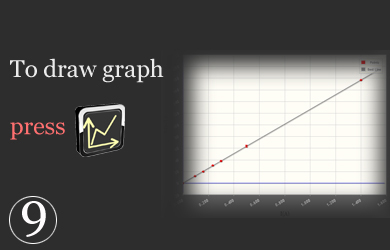
Draw Best Line