(MW2-2) Microwave, Standing Waves
Microwaves are:
1
electromagnetic waves
2
negatively charged ions
3
rapidly moving electrons
4
rapidly moving protons
5
rapidly moving neutrons
Microwaves wave length about:
1
0.1 to 10 nm
2
0.1 to 10 km
3
0.1 to 10 cm
4
0.1 to 10 pm
5
0.1 to 10 m
A standing wave:
1
can be constructed from two similar waves traveling in opposite directions
2
must be transverse
3
must be longitudinal
4
has motionless points that are closer than half a wavelength
5
has a wave velocity that differs by a factor of two from what it would be for a traveling wave
If λ is the wavelength of each of the component sinusoidal traveling waves that form a standing wave, the distance between adjacent nodes in the standing wave is:
1
λ/4
2
λ/2
3
3λ/4
4
λ
5
2λ
A standing wave pattern is established in a string as shown. The wavelength of one of the component traveling waves is:
1
0.25m
2
0.5m
3
1m
4
2m
5
4m
Standing waves are produced by the interference of two traveling sinusoidal waves, each of frequency 100Hz. The distance from the second node to the fifth node is 60 cm. The wavelength of each of the two original waves is:
1
50 cm
2
40 cm
3
30 cm
4
20 cm
5
15 cm
A microwave of length L vibrates in a standing wave pattern. Thewavelengths of the constituent traveling waves CANNOT be:
1
L
2
2L
3
L/2
4
2L/3
5
4L
Fully constructive interference between two sinusoidal waves of the same frequency occurs only if they:
1
travel in opposite directions and are in phase
2
travel in opposite directions and are 180◦ out of phase
3
travel in the same direction and are in phase
4
travel in the same direction and are 180◦ out of phase
5
travel in the same direction and are 90◦ out of phase
Fully destructive interference between two sinusoidal waves of the same frequency and amplitude occurs only if they:
1
travel in opposite directions and are in phase
2
travel in opposite directions and are 180◦ out of phase
3
travel in the same direction and are in phase
4
travel in the same direction and are 180◦ out of phase
5
travel in the same direction and are 90◦ out of phase
The distance between consecutive node and anitnode is:
1
λ
2
λ/2
3
2λ
4
λ/4
For destructive interference of microwaves the path difference between two interfering microwaves should be:
1
n λ
2
(n+1/2) λ
3
some time n? and some times (n+1/2) λ
4
none of these
The distance between two consecutive nodes is:
1
λ /2
2
λ /4
3
λ
4
2 λ
Submit
Exit
Submit
Next
Result:
Show correct answer
Hide
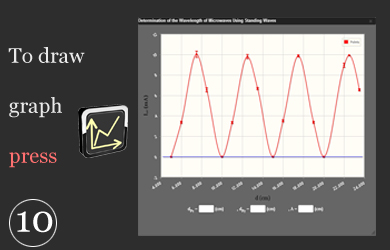
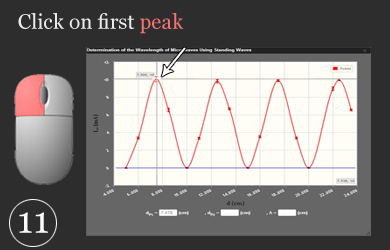
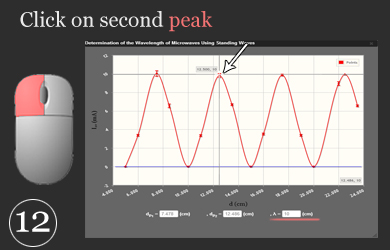
d
p
1
=
(cm) ,
d
p
2
=
(cm) ,
λ =
(cm)